Where Leads Actually Disappear in a Small Business
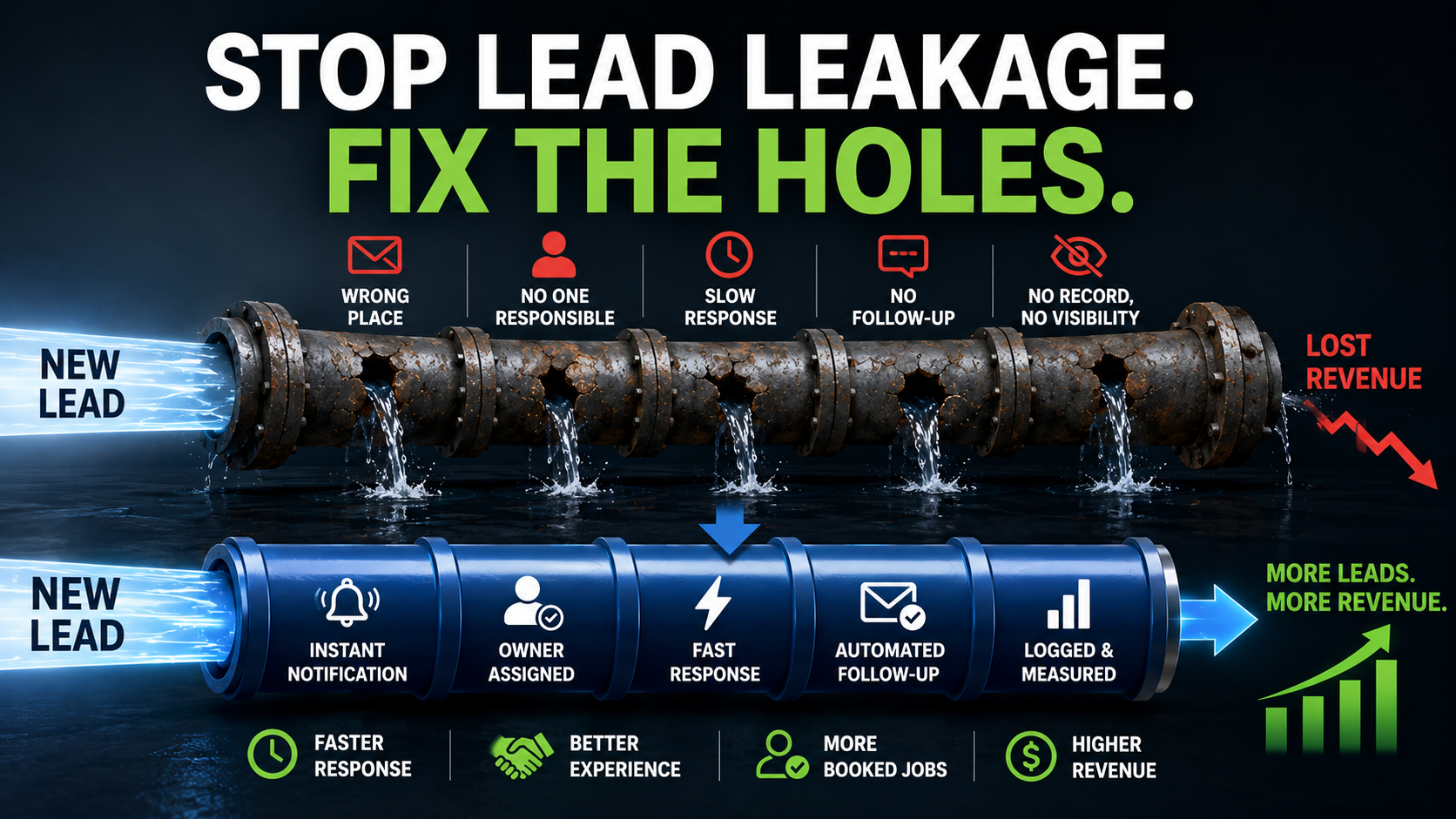
Most small businesses don’t have a lead problem. They have a lead leakage problem.
The leads come in. They fill out the form, they call the number, they send the email. And then somewhere between that moment and the moment someone actually responds, the lead disappears. Not because the business doesn’t care. Because the system between “lead comes in” and “lead gets handled” has holes in it, and nobody’s mapped them.
I’ve seen this pattern enough times that I can almost draw it from memory. The details change. The shape doesn’t.
A typical lead flow, with all its holes
Here’s a version I’ve seen at a dozen small service businesses. Names and details are composited, but the pattern is real.
A potential customer lands on the website. They fill out a contact form. The form sends an email to the business’s Gmail inbox. It lands between a vendor invoice and a newsletter. Nobody sees it for a day, maybe two. Eventually the owner spots it, opens it, and texts the person back from their personal phone. The lead already booked someone else. Or they don’t respond because they don’t recognize the number.
That’s five leak points in one sequence. Each one is fixable. Most of them are cheap to fix. And together they’re probably costing more than the business’s entire marketing budget.
Leak one: The form sends to the wrong place
This is the most common one and the most absurd. A business spends real money getting people to the website. SEO, ads, word of mouth, whatever. Someone arrives, decides they’re interested, fills out the form. And the form sends an email to a general inbox that three people sort of monitor and nobody owns.
The fix is simple. The form submission should go somewhere with a notification attached to it. A CRM, a shared channel, a dedicated inbox with push alerts on someone’s phone. It doesn’t have to be fancy. It has to be seen within minutes, not hours.
If the form also logs the submission in a spreadsheet or a database, even better. Email is a terrible system of record. Leads that live only in an inbox get buried, deleted, or forgotten. A lead that’s logged somewhere persistent can be tracked, followed up on, and measured.
Leak two: Nobody specific is responsible
A lead comes in and three people might see it. The owner, the office manager, the receptionist. All three assume one of the other two will handle it.
This kills more leads than slow response time does. At least a slow response is a response. A lead that falls into a shared-responsibility gap gets no response at all.
The fix: one person owns new leads. Period. If that person is unavailable, there’s a named backup. This is an org decision, not a technology decision, but it’s the one that matters most. No tool fixes a lead flow where nobody’s job it is to respond.
Leak three: The two-day response
Someone fills out a form on Tuesday afternoon. The owner sees it Wednesday night. Texts back Thursday morning from a personal cell number the lead doesn’t recognize. By Thursday the lead has already called two competitors, gotten a quote from one, and booked.
The research on this is consistent. Response time is the single biggest factor in whether a lead converts. Not price, not quality, not reputation. Speed. A lead contacted within five minutes is dramatically more likely to convert than one contacted in an hour. An hour is better than a day. A day is better than two days. Two days is basically a coin flip against the lead being gone.
The fix has two layers. First, make sure the person responsible gets a real-time notification the moment a lead comes in. Not an email they’ll check later. A push notification, a text, something that buzzes.
Second, automate the first touch. An automatic reply that goes out within a minute of the form submission, from the business (not from “noreply@”), confirming the inquiry was received and setting an expectation for when they’ll hear back. That buys time. The lead knows they were heard. The owner can follow up with a real response within the hour instead of panicking about the five-minute window.
Leak four: No second touch
This one is quieter. The owner responds, the lead doesn’t reply right away, and the thread dies. No follow-up. No second message. Nothing.
Most leads don’t convert on the first touch. They’re busy. They’re comparing. They meant to reply and forgot. A single follow-up two or three days later recovers a surprising number of these. A second follow-up a week later catches a few more.
Almost nobody does this consistently. Not because they don’t know they should. Because it’s manual, it’s easy to forget, and when you’re running a business there’s always something more urgent than sending a “just checking in” text to someone who might not even be interested.
The fix is automation. A simple sequence: if a lead hasn’t responded in 48 hours, send a short follow-up. If they haven’t responded in a week, send one more. Two or three touches, spread across a week, each one brief and useful. That’s it. It can be automated completely and it recovers leads that would otherwise just vanish.
Leak five: No record of what happened
A lead comes in, gets handled (or doesn’t), and there’s no record. Did they book? Did they ghost? Did someone follow up? Nobody knows. The owner has a vague sense that leads come in and some turn into jobs, but there’s no way to measure how many came in, how many were contacted, how fast, and how many converted.
Without that, you can’t fix anything. You’re just guessing about which part of the funnel is broken.
The fix is a system of record. It doesn’t have to be Salesforce. A simple CRM, even a well-structured spreadsheet to start, where every lead gets logged with a status. New, contacted, quoted, booked, lost. Now you can see where leads stall. Now you can measure whether the changes you made actually helped.
What the fixed version looks like
Same scenario, same lead, same Tuesday afternoon.
The lead fills out the form. Within sixty seconds, they get an email: “Got it. We’ll be in touch within the hour.” At the same time, a notification hits the owner’s phone with the lead’s name, service interest, and message. The lead is automatically logged in a CRM with a status of “new.”
The owner calls back within twenty minutes. The call comes from the business number, not a personal cell. If the lead doesn’t pick up, the owner leaves a voicemail and the system queues a follow-up text for the next morning. If no response after 48 hours, another short follow-up goes out. After a week, one final check-in.
Every step is logged. At the end of the month, the owner can see: 30 leads came in, 28 were contacted within an hour, 18 got a quote, 12 booked. And the two who fell through the cracks are visible, not invisible.
None of this requires expensive software. The automation layer is simple. The CRM can be lightweight. The hard part isn’t the technology. The hard part is admitting the current system has holes and deciding to map them.
The real cost
The uncomfortable math: if a business gets 20 leads a month and loses five of them to slow response, missed follow-ups, or emails nobody saw, that’s five lost jobs every month. Multiply by average job value and twelve months. The number is usually large enough to make the fix feel obvious in hindsight.
The question for most small businesses isn’t whether they’re losing leads. It’s how many, and at which step. The only way to find out is to trace the path a lead actually takes from first contact to booked job, be honest about where it breaks, and fix the holes one at a time.
Have a project in mind? We'd love to hear about it.
Start a conversationRelated posts
Private Equity Bought Your Competitor and Gave Them a Tech Stack
PE-backed roll-ups are winning home services on response speed and booking systems. Most of that stack is rentable. Here's how to keep up.
Build an AI Review-Triage Workflow That Saves You Two Hours a Week
A step-by-step setup for pulling reviews from every platform into one daily summary with sentiment flags and draft responses ready for your edit.
The AI Automations That Actually Earn Their Keep in a Small Business
A practical list of the AI automations that pay back the setup time for a small business, the ones that are oversold, and where to start.