The Follow-Up Email You're Not Sending Is Your Cheapest Growth Lever
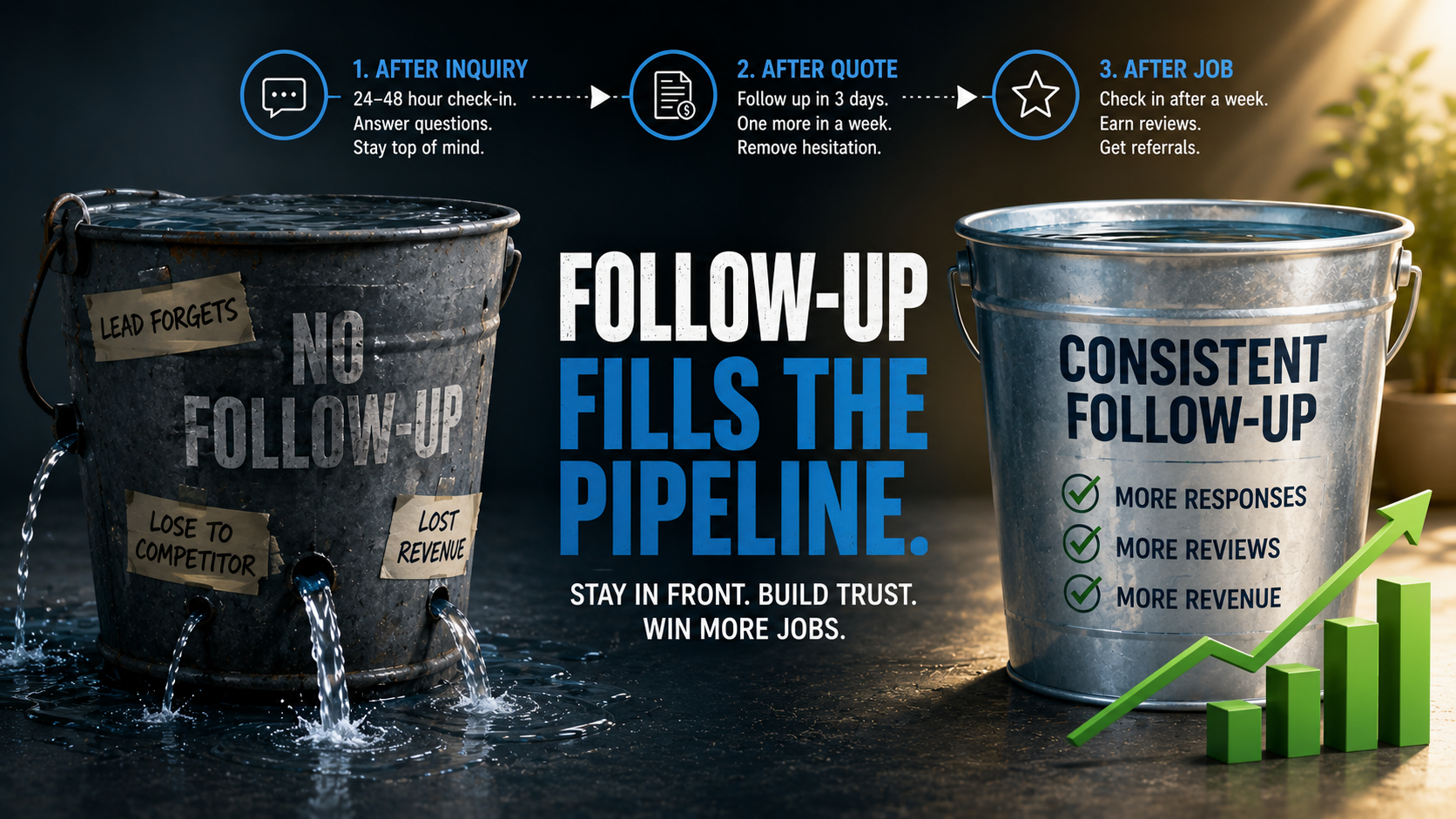
Here’s how follow-up works at most small businesses I’ve talked to. A lead comes in, someone sends a quote or answers the question, and then nothing. The ball is in the customer’s court. If they come back, great. If they don’t, the lead is dead.
Nobody decided it should work this way. It just does. The owner is busy. There’s no system. Following up feels pushy. So the quote goes out, silence follows, and everyone moves on.
That silence is expensive.
What actually happens when you don’t follow up
Think about it from the customer’s side. They reached out to three businesses. They got three quotes. Yours was fine. But then one of the other companies sent a short note two days later asking if they had any questions. That company felt more attentive, more professional, more like someone who would actually show up and do the work. The customer called them back.
Your quote wasn’t the problem. Your silence was.
This plays out constantly. The customer meant to reply. They got busy. They forgot which company was which. The one that followed up is the one they remember. The math is simple and unforgiving: the business that stays in front of the customer after the first conversation wins a larger share of jobs than the business that doesn’t, even when the quotes are identical.
The three follow-ups most businesses don’t send
There are three moments where a follow-up makes a measurable difference, and most small businesses miss all three.
After the inquiry
A lead fills out a form or calls. Someone responds. Then what? If the lead doesn’t immediately book, most businesses wait. A short message 24 to 48 hours after that first contact, checking whether they have questions or need anything else, recovers a real percentage of leads who were interested but got distracted. This is the easiest follow-up to send and the one with the most immediate payoff.
After the quote
The quote goes out. The customer says they’ll think about it. This is where nearly every small business stops. A follow-up three days later, brief and low-pressure, does two things. It reminds the customer you exist (they’ve been looking at other quotes). And it gives them a natural moment to say yes without feeling like they have to initiate the conversation.
One more follow-up a week after that, if they still haven’t responded, is worth sending. Keep it short. Something like “just wanted to check in, no rush, happy to answer any questions.” That’s it. Two follow-ups after the quote. Not ten. Not zero. Two.
After the job
This is the one almost nobody does, and it’s quietly the most valuable. A message a week after the job is done, asking how it went, whether anything needs attention. It does three things at once: it catches problems before they become bad reviews, it prompts satisfied customers to leave a review (most people will if asked at the right moment), and it keeps the door open for repeat work and referrals.
The businesses I’ve seen add a post-job follow-up consistently get more reviews and more repeat bookings. Not because the follow-up is clever. Because they’re the only company that bothered to ask.
The revenue math
I want to make this concrete. Take a service business that gets 30 leads a month and closes 10 of them. That’s a 33% close rate. Average job value is $1,500. Monthly revenue from new leads: $15,000.
Now add a follow-up sequence. Industry data on follow-up effectiveness varies, but the consistent finding across multiple studies is that structured follow-up improves close rates somewhere in the range of 20 to 40 percent. Use the conservative end. A 20% lift on a 33% close rate moves it to about 40%. That’s 12 closed jobs instead of 10.
Two extra jobs a month at $1,500 each. $3,000 a month. $36,000 a year. From sending a few short emails that you didn’t send before.
The post-job follow-up adds to that, but it’s harder to quantify because the payoff is reviews and referrals, which compound over time rather than showing up in next month’s numbers. Still real. Just slower.
Plug in your own numbers. The math almost always makes the case, even at the low end of the estimates, even for businesses with smaller job values. The lift doesn’t have to be dramatic for the return to be obvious.
Why this is a cheap automation
Here’s the part that makes this feel unfair. This whole sequence, the post-inquiry check-in, the post-quote follow-ups, the post-job message, can be automated. Once it’s built, it runs without anyone thinking about it.
The follow-up emails are templated. The timing is set. When a lead reaches a certain status (quoted, completed), the sequence triggers. The owner doesn’t have to remember. The system does.
Building this doesn’t require enterprise software. A lightweight CRM or even a simple automation tool can handle it. The messages themselves are short, plain, and personal-sounding. Three or four templates, a few timing rules, and you’re done. A few hours to set up. No ongoing effort after that.
Compared to most things a small business can spend money on to grow revenue, an automated follow-up sequence has one of the best ratios of cost to return. It’s not glamorous. Nobody’s writing case studies about follow-up emails. But the math works every time, and the businesses that have this running quietly close more than the ones that don’t.
The reason most businesses still don’t do this
It’s not ignorance. Most owners know they should follow up more. The problem is consistency. When follow-up depends on a person remembering to do it between running jobs, managing employees, handling billing, and everything else, it doesn’t happen. Not because the owner is lazy. Because manual follow-up competes with everything else for attention, and everything else feels more urgent.
That’s why the automation part matters. Not because the emails are complicated. Because the only follow-up sequence that works is the one that doesn’t depend on someone remembering to send it.
The question isn’t whether follow-up works. Everyone knows it does. The question is whether you have a system that does it for you, or whether you’re relying on willpower that has a hundred other things competing for it every day.
Have a project in mind? We'd love to hear about it.
Start a conversationRelated posts
Private Equity Bought Your Competitor and Gave Them a Tech Stack
PE-backed roll-ups are winning home services on response speed and booking systems. Most of that stack is rentable. Here's how to keep up.
Build an AI Review-Triage Workflow That Saves You Two Hours a Week
A step-by-step setup for pulling reviews from every platform into one daily summary with sentiment flags and draft responses ready for your edit.
Where Leads Actually Disappear in a Small Business
A walkthrough of the five places small businesses lose leads between form fill and booked job, and what to do about each one.