SEO Is Dying. Here's What Replaces It.
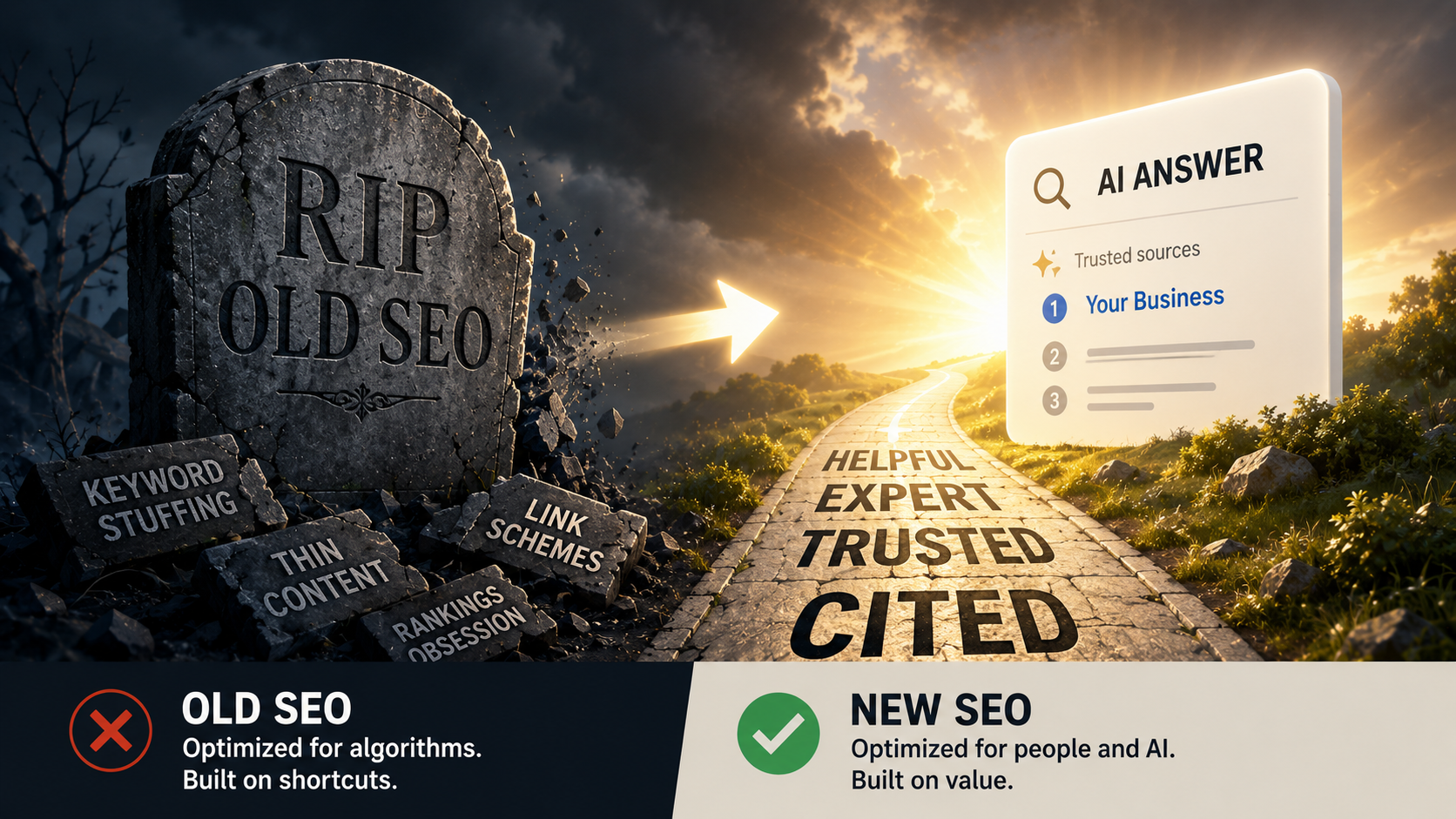
SEO isn’t exactly dying. The version of SEO that most small businesses are actually doing is.
The keyword-stuffed page, the thin content written to match a phrase, the spreadsheet tracking fifty rankings for queries nobody would put in a sentence. That approach has been losing ground for years. AI search is finishing it off.
What replaces it isn’t a new acronym. It’s something that was always the right answer and is now the mandatory one.
The part of search that’s actually changing
People still Google. Google still sends enormous traffic. That’s not the thing that’s changed.
What’s changing is the research phase. The part where someone decides who they’re going to call, what tool they’re going to buy, or whether they have a problem worth solving. That phase used to happen on the Google results page. Increasingly, it happens in a chat window.
A business owner trying to figure out whether they need a CRM isn’t typing “small business CRM” into Google and clicking through five review sites anymore. They’re asking ChatGPT or Perplexity a long, specific question and reading a synthesized answer. The answer cites some sources and ignores most of the internet.
If you’re not one of the cited sources, you’re not in that decision at all.
Google has moved in the same direction with AI Overviews. Search a question now and there’s a good chance the top of the page is an AI-generated summary with a few citations, not a list of links. The links are still there. But users often don’t need to click them.
What gets you cited versus what gets you ranked
These are not the same thing. That’s the part most people are missing.
Getting ranked on Google has historically rewarded signals: backlinks, keyword density, page authority, time on page. These are proxies. Google can’t always tell if a page is genuinely useful, so it uses measurements that correlate with usefulness.
Getting cited in an AI answer works differently. The model reads your content and pulls the most direct, clear answer to the question being asked. Keyword density doesn’t help. A clean, quotable sentence that directly answers a specific question does.
If someone asks ChatGPT “what does AI automation cost for a small business” and your site has a page that clearly and honestly answers it, you have a shot at being cited. If your site mentions “AI automation pricing” nine times without answering the question, you don’t.
That’s a mechanical difference, not a subtle one.
This is the core of generative engine optimization, or GEO: writing content that AI models can actually trust and quote, not just content that checks the right boxes for a crawler. The optimization target has moved from signals of relevance to actual relevance.
Why topical authority matters more now
Here’s the part that catches people off guard. AI models don’t evaluate pages in isolation.
They develop an implicit picture of which sources are authoritative on which topics, based on the breadth and consistency of what those sources have published. A site that has put out fifteen substantive pieces about automation for service businesses, each one specific and well-researched, will be treated differently than a site that published one good page three years ago and nothing since.
The body of work is the signal.
I’ve watched this play out with clients. A business that has been writing consistently about their domain gets picked up as a source for related queries they didn’t specifically target. One that published one decent page and stopped doesn’t. The pattern is consistent enough that it’s not a coincidence.
Topical authority can’t be rushed. You can’t shortcut your way into being recognized as an expert with a content sprint. AI models, like humans, take time to develop trust in a source. A month of publishing doesn’t establish a pattern. A year does.
Which means the businesses starting now have a genuine head start on the ones who’ll notice the shift later.
What this changes about content strategy in practice
The frame shifts from “what do I need to rank for” to “what questions do my customers actually ask, and can someone read my answer and trust me.” That sounds obvious stated plainly. It changes a lot of decisions.
Write for one topic deeply, not many topics shallowly. If you serve small businesses with AI tools, write about AI agents. Write about workflow automation. Write about the failure modes. Write about specific tools with honest tradeoffs. Not all at once. Consistently, over time, until you’re the clear source on that topic for anyone researching it.
Write to be quoted, not just to rank. Each section of each piece should answer a real question directly, in plain language that makes sense when pulled out of context. That’s the sentence that ends up in an AI answer. A page that meanders toward an answer doesn’t get cited. A page that leads with the answer does.
The technical basics haven’t changed. Fast site, real backlinks, clean structure, pages that load on a phone. Those still matter. But they’re the floor, not the strategy. “Publish content with keywords” is no longer a sufficient frame for the strategy layer.
The honest bottom line
The businesses that will own AI search results two or three years from now are mostly building that position today. Topical authority compounds slowly and takes time to establish. Starting now puts you ahead of most of your competition, which is still optimizing for a version of search that’s already being replaced.
The question isn’t whether this matters. It’s whether you start before or after the shift becomes obvious to everyone else.
Have a project in mind? We'd love to hear about it.
Start a conversationRelated posts
How to Show Up in ChatGPT and Google AI Overviews When Customers Search Your Industry
The practical steps a small business can take this week to get cited in ChatGPT, Google AI Overviews, and other AI answer engines.
GEO vs SEO: What Generative Engine Optimization Is and Why It Matters Now
What GEO is, how it differs from SEO, and why small businesses need their websites to be found by AI answer engines too, not just Google.
Private Equity Bought Your Competitor and Gave Them a Tech Stack
PE-backed roll-ups are winning home services on response speed and booking systems. Most of that stack is rentable. Here's how to keep up.