GEO vs SEO: What Generative Engine Optimization Is and Why It Matters Now
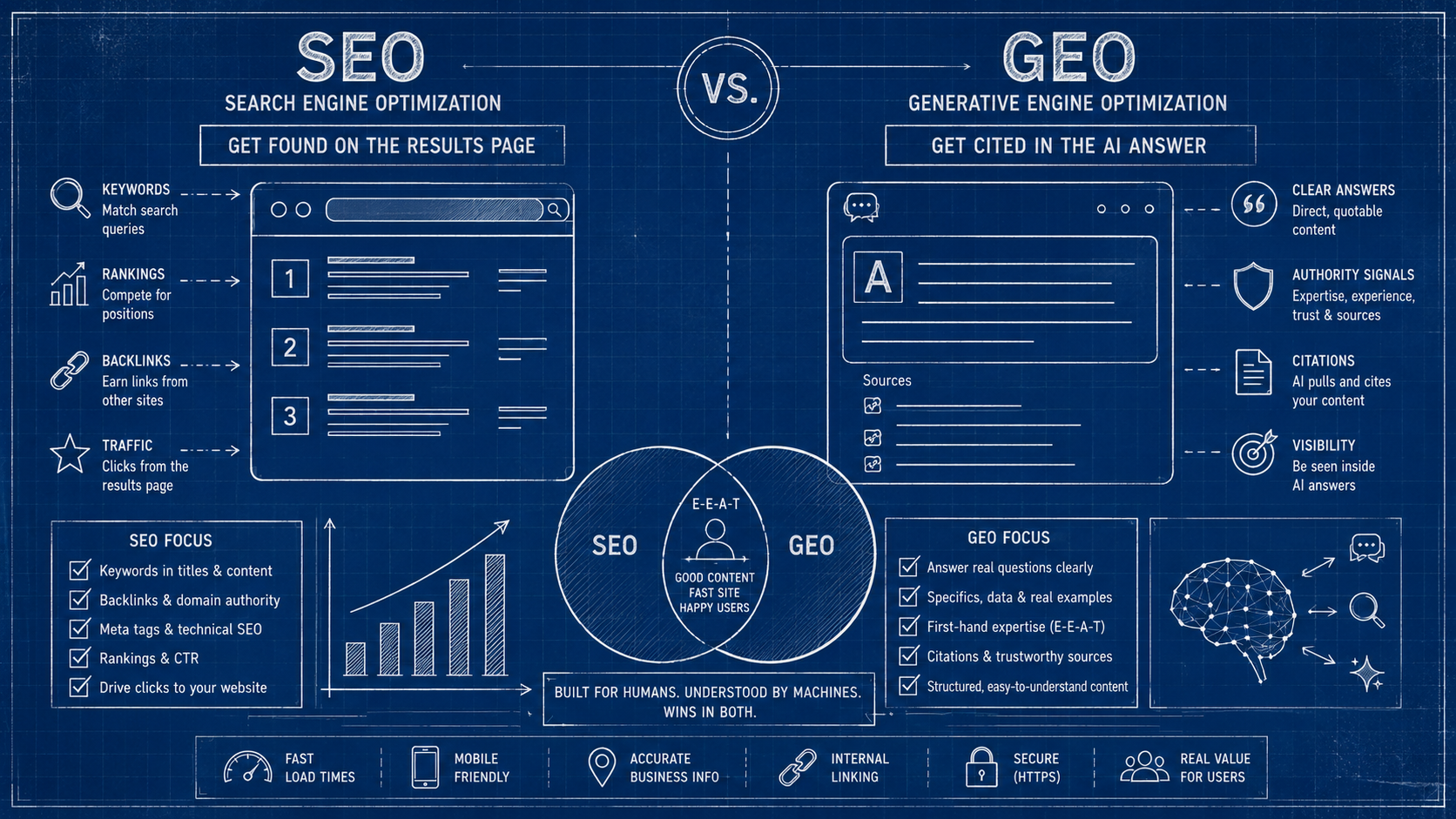
There’s a new acronym making the rounds, which is usually a bad sign. This time it’s GEO. Generative Engine Optimization. And against the odds, it’s pointing at something real.
The short version: GEO is the practice of getting your website cited and quoted by AI answer engines like ChatGPT, Claude, Perplexity, and Google’s AI Overviews. SEO is the practice of getting your website ranked on the Google results page. They overlap. They aren’t the same. And a growing chunk of your customers are skipping the results page entirely and just asking an AI, which means the second one is no longer optional.
What GEO actually is
GEO is writing and structuring your website so that AI answer engines, the systems that generate answers instead of listing links, can understand, trust, and quote your content.
The term comes from a 2023 academic paper out of Princeton called “GEO: Generative Engine Optimization.” The researchers tested what kinds of content changes made a piece more likely to be cited by generative search systems. The short answer: clear definitions, direct quotable claims, cited sources, and concrete specifics moved the needle. Vague hype did not.
If that sounds a lot like “good writing,” it’s because it largely is. The twist is that the writing is being read by a machine first, and the machine is the one deciding whether to hand your sentence to a customer.
Why this matters now
A year ago you could ignore this. Today you can’t.
Google now shows an AI Overview at the top of a lot of searches. ChatGPT has hundreds of millions of weekly users and a built-in search mode that summarizes from web sources. Perplexity is built entirely around answers with citations. Bing has Copilot. Apple is folding ChatGPT into Siri.
When a person asks one of these tools “who does HVAC repair in my town,” or “what’s the best CRM for a 5-person agency,” or “do I need an LLC or an S-corp,” they get an answer. Sometimes that answer comes with source links. Sometimes it doesn’t. Either way, the click that used to land on a Google result page now lands inside a chat window, and the question of whose information shaped that answer is the new question.
That’s the part that’s changed. Not whether SEO works. SEO still works. The change is that there’s a second front now, and it has its own rules.
How SEO and GEO are different
The rough split:
- SEO loves keywords. GEO loves clear answers. A page stuffed with the phrase “best AI agent for small business” twelve times can still rank. The same page does badly with an LLM, because the LLM is pulling sentences that answer the question, not strings that match the question.
- SEO is judged on rankings. GEO is judged on whether you got cited at all. There is no top ten list. Either the AI mentioned you or it didn’t.
- SEO leans on backlinks. GEO leans on the authority signals inside the writing itself. Real expertise, named specifics, real sources, first-hand stance. The things that make an LLM trust a page are mostly the things that make a human trust it too.
- Google searches are short fragments. AI prompts are full sentences. “Plumber austin” vs. “who’s a good plumber in north Austin who does Saturday calls.” Your content has to answer the second kind, not just match the first.
The good news is that the two overlap more than they fight. Most things that help GEO also help modern SEO, because Google’s own ranking signals have been moving in the same E-E-A-T direction (Experience, Expertise, Authoritativeness, Trust) for years. Writing clearly, being specific, and signaling that a real human with real knowledge made the page is the right answer for both.
What it actually looks like to do this
Some of what GEO asks for is just writing well. Some is more specific. Here’s the practical shortlist for a small business website:
- Answer real questions directly, in plain sentences. Each page should clearly answer what a customer would actually ask. Not “About Our Services,” but “what does an HVAC tune-up include, and how much should it cost.” The sentence that answers the question is the sentence the AI is going to lift.
- Define your terms once, cleanly. If your industry uses jargon, define it in one short, standalone sentence somewhere on the relevant page. That’s the citation candidate.
- Be specific. Real prices or honest ranges. Real timelines. Real service areas. Real examples. LLMs and customers both reward specifics and both distrust mush.
- Show first-hand expertise. Who you are, how long you’ve done this, what you’ve actually seen go right and wrong. This reads as E-E-A-T to Google and reads as authority to an LLM.
- Use schema and structured data where it makes sense. It isn’t magic, but giving machines a clean read of your business (name, location, hours, services) costs nothing and helps both kinds of search.
- Don’t accidentally block the bots that would cite you. Some small business sites have aggressive robots rules left over from old templates. If the AI can’t read your page, it can’t quote your page.
- Keep doing the SEO basics. Fast pages, real backlinks, clean titles, working internal links, a site that loads on a phone. Skipping the basics because you read a blog post about GEO is how to lose at both.
I’ve seen a few owners get genuinely worried about GEO while their existing site still loads in eight seconds on a phone and doesn’t put a phone number on the homepage. The basics still matter more than the new acronym. Fix the slow site first. Then optimize for the robots.
If your site is already well-built and well-written for humans, you’re closer to GEO-ready than you think. If it’s a 2017 template with thin pages full of keyword soup, you now have two problems instead of one.
The real question
You don’t have to pick. SEO isn’t dying. Google still sends a huge amount of traffic, and that isn’t going to vanish next quarter. But the share of customer questions answered by AI instead of by a results page is going up, not down, and the website that gets cited by the AI is now part of how you get found.
The honest framing is this. SEO gets you on the page. GEO gets you into the answer. Most small businesses need both, most aren’t doing either particularly well, and the ones who fix it early will quietly own a lot of search real estate while everyone else is still arguing about whether AI search is real.
It’s real. It’s small but growing fast. And the work to be ready for it is mostly the same work that makes your site better anyway. That’s the part that should make this easier to start, not harder.
Have a project in mind? We'd love to hear about it.
Start a conversationRelated posts
How to Show Up in ChatGPT and Google AI Overviews When Customers Search Your Industry
The practical steps a small business can take this week to get cited in ChatGPT, Google AI Overviews, and other AI answer engines.
SEO Is Dying. Here's What Replaces It.
Google AI Overviews and ChatGPT changed the research phase of customer decisions. Here's what GEO and topical authority mean for your content strategy.
Private Equity Bought Your Competitor and Gave Them a Tech Stack
PE-backed roll-ups are winning home services on response speed and booking systems. Most of that stack is rentable. Here's how to keep up.